We Don’t Need More Content
Last Updated on: March 28, 2026
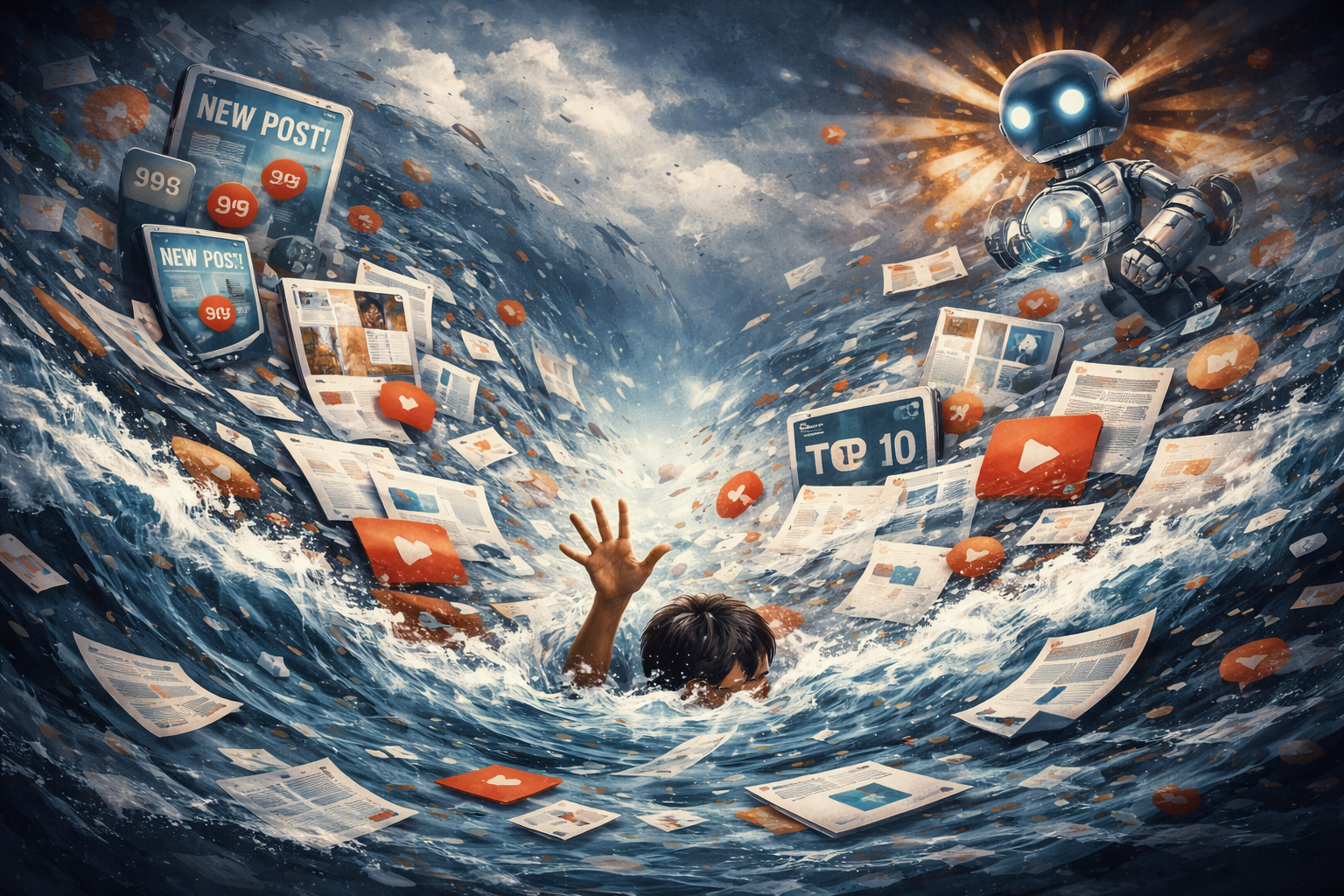
There has never been more content than there is right now. More blog posts, more videos, more podcasts, more newsletters, more tweets, more everything. Every second, the internet gets heavier. And for decades, the answer to every business question, every marketing challenge, every personal brand ambition has been the same: make more.
Then AI showed up. And we are using it to make more content, faster than ever before.
That’s the bit that should bother us.
The flood
AI-generated content is already everywhere. Social media posts, news articles, support tickets, product descriptions, print magazines, memes, profile pictures, scam videos. It’s in places you’d expect and places you wouldn’t. The volume was already unmanageable before large language models entered the picture. Now it’s accelerating in a way that makes the old internet look quaint.
Every tool, every platform, everyone with a course to sell is focused on the same thing: creation. Write faster. Publish more. Automate your output. Scale your content machine. The entire ecosystem is optimised for production, and AI has supercharged the worst instinct we already had.
Nobody stopped to ask whether we needed more in the first place.
The wrong superpower
Here’s the thing about AI and content creation: producing more of it is the easiest, least interesting thing AI can do. It’s the party trick. The demo that makes people clap. But it’s not where the real value is.
The real promise of AI isn’t creation. It’s improvement.
Think about what’s already out there. Millions of articles, research papers, tutorials, explainers, guides, and resources covering virtually every topic humans have ever thought about. The knowledge exists. The problem is that it’s scattered, inconsistent, badly written, hard to find, harder to verify, and almost never presented in a way that works for the person reading it.
AI could fix that. It could take all of that information and organise it. Condense it, make it readable, verify it, make it genuinely accessible. Not by adding to the pile, but by making sense of what’s already there.
Knowledge, tailored
Take a Wikipedia article about black holes. It’s thorough. It’s also dry, dense, and written for an audience that apparently already has a physics degree. For most people, it’s a wall of text they’ll bounce off within thirty seconds.
Now imagine that same article rewritten just for you. Based on what you already know, your age, your reading level, how much time you have, what you read last week. A fourteen-year-old who just watched Interstellar gets a different version than a postgrad researcher. Same knowledge, different delivery. Both walk away having actually learned something.
Take it further. You tell AI you want to learn about space. Instead of 400 million search results, you get a curated path: articles at your level, short videos that build on each other, quizzes to check understanding, people worth following. Not a content firehose. A curriculum. The benefit could be astronomical. (Sorry.)
This is what AI should be brilliant at. Not generating another ten thousand articles about black holes, but taking the best of what exists and presenting it in a way that actually works for each individual person.
The missed opportunity
Instead, we’re using the most powerful knowledge tool ever built to generate noise. More SEO filler. More social media posts for the algorithms. More emails nobody reads. We finally have something that could make human knowledge genuinely accessible, personalised and useful, and we’ve pointed it at the content treadmill.
AI shouldn’t be a signal that more content is coming. It should be a signal that content has been fact-checked, organised, and presented the way we actually want to consume it. Less creation. More curation. Less volume. More value.
We don’t need more content. We never did. We need what we already have to finally make sense.
Get notified of new posts: